
• Skip to primary navigation
  • Skip to main content
  • Skip to primary sidebar
  • Skip to footer
  • How to Use
  • Contact
  • Consumer
  • Industry
  • Trade
  • Blog
Oregon Wine Resource Studio

Oregon Wine Resource Studio

Your Resource for Oregon Wine Trade Presentations

  • Resources
    • View All
    • Topics
      • Oregon Overview
      • Master Classes
      • AVAs
      • History
      • Varieties
      • Labeling Regulations
      • Environmental Stewardship
    • Media Types
      • Map
      • Presentation
      • Tech Sheet
      • Podcast
      • Video
  • Programs
    • Trade Events
    • Oregon Wine Month
  • Media Library
  • Account
    • Logout
    • Log In
    • Sign Up
  • s
  • 0 files
Slide background

Labeling Regulations

Labeling regulations

Early on, Oregon’s winemakers realized they had something special here, something distinct and deserving of distinction in a crowded marketplace. They didn’t have to, but Oregon’s wine industry pressed for labeling regulations stricter than those required by the federal government. It was — and is — a matter of integrity. Recognizing the importance of place and variety in the creation of wines, Oregon’s labeling regulations reflect the approach of its winemakers since the industry’s founding days: principled, honest, clear.

Labeling regulations download

Labeling Regulations(Added to cart. Click to checkout!) Added to cart

Presentation preview

About

Oregon maintains some of the strictest wine labeling regulations of any state regarding declaration of grape origin and varietal.

The Alcohol and Tobacco Tax and Trade Bureau (TTB) developed a set of federal wine labeling regulations to ensure the integrity of alcoholic beverages in the marketplace and to accurately inform customers. The TTB has created an informative brochure about these federal regulations. In addition to the TTB federal rules, Oregon has enacted stricter regulations to ensure the integrity and quality of Oregon wine.

Appellation of Origin

The most influential additions to the TTB wine labeling regulations in Oregon are the provisions about declaring a wine’s appellation of origin. Federally, if a wine label lists a country, state or county as an appellation, at least 75% of the wine must be produced from grapes grown in the place named, and at least 85% if the label lists a specific American Viticultural Area (AVA) such as Napa Valley.

In Oregon, if the label claims or implies “Oregon,” an Oregon county, or an AVA wholly within Oregon, 100% of the grapes must be from Oregon and 95% from that appellation of origin.

oregon-wine-origin-labeling-table-110116

Exceptions to this rule apply to wines declaring cross-border AVAs, such as the Walla Walla Valley and Columbia Gorge, for which AVA labeling may follow laws of either state. Washington State follows the TTB’s guidelines of 85%. However, 100% of the grapes must come from the two states.

Varietal Declaration

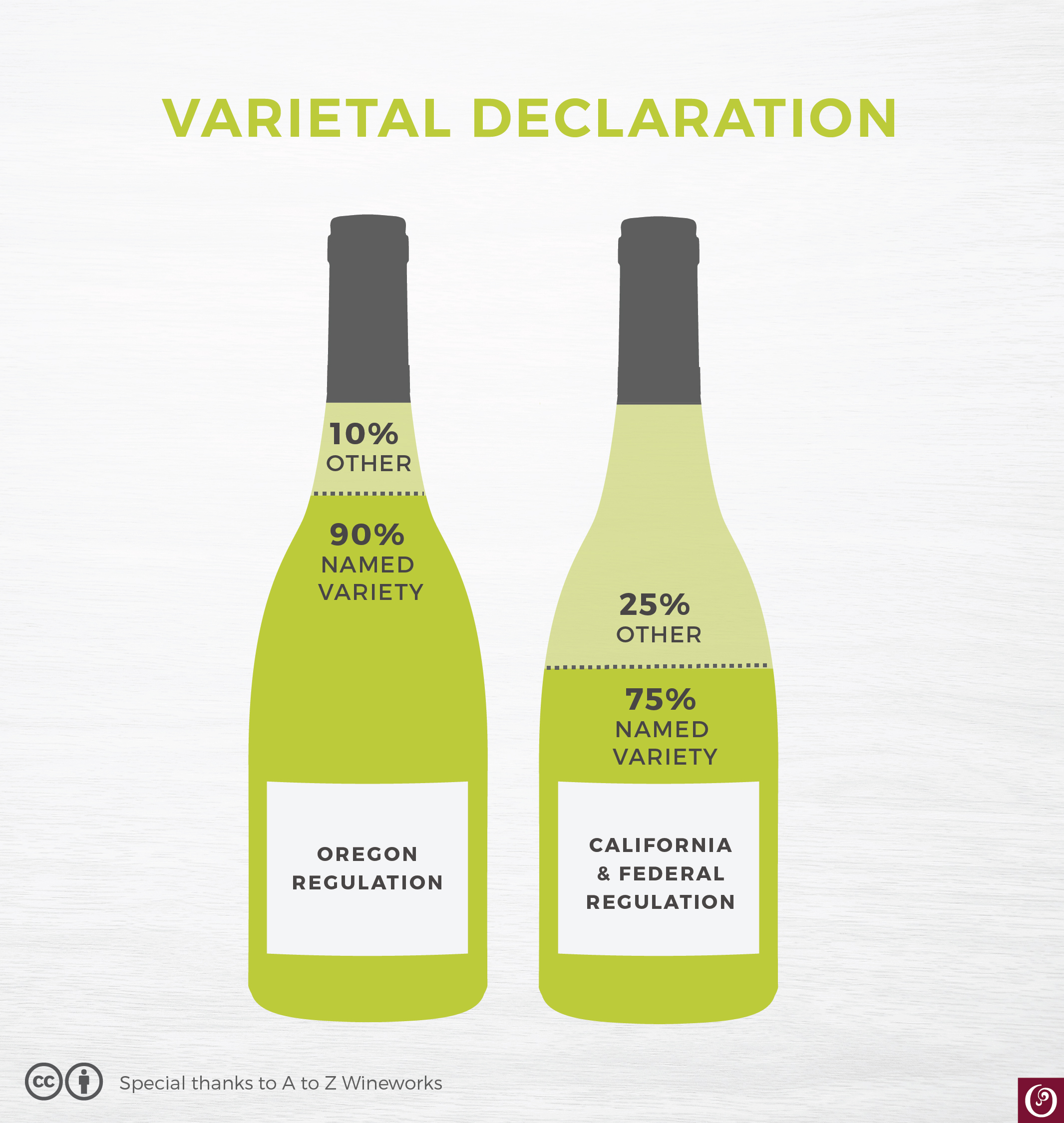
Oregon also has stricter regulations than other U.S. regions when it comes to labeling the varieties used in a wine. Federal regulation states that at least 75% of grapes used to make a wine must be of the declared variety in an identified appellation of origin. In Oregon, 90% or more of the wine must be from the named variety, including Oregon’s most widely produced wines: Pinot noir, Pinot gris, Chardonnay, Pinot blanc and 50 other varieties known to grow in Oregon.

However, there are 18 grape varieties exempted from Oregon’s 90% minimum requirement for varietal labeling and allowed to be blended with up to 25% other varieties. These include: Cabernet franc, Cabernet Sauvignon, Carmenere, Petite Sirah, Grenache, Malbec, Marsanne, Merlot, Mourvedre, Petit Verdot, Roussanne, Sangiovese, Sauvignon blanc, Semillion, Syrah, Tannat, Tempranillo and Zinfandel. These varieties have a long history of being used for blending in their respective European regions, and the exemption allows vinification following in their historical tradition.
oregon-wine-varietal-declaration-chart-110116-1

By making the regulations regarding declaration of appellation of origin and varietals stricter than the federal regulation, the Oregon wine industry is able to protect and properly represent the state’s terroir, and therefore its quality. For additional information on Oregon wine labeling regulation read this document released by the Oregon Winegrowers Association.

In addition to the implementation of stricter labeling rules, Oregon was also an original signatory of the Joint Declaration to Protect Wine Place and Origin, a set of principles shared by 19 wine regions across the world aimed at educating consumers about the importance of location to winemaking. To learn more about this program visit www.wineorigins.com.

Primary Sidebar

Access All Downloads

RELATED DOWNLOADS

The Full Story

Industry History

Labeling Regulations

Environmental Stewardship

Related downloads

The Full Story

Templates

Footer

Creative Commons License  Creative Commons License

Oregon Wine Resource Studio by Oregon Wine Board is licensed under a Creative Commons Attribution 4.0 International License.

Learn More

  • Our commitment to change
  • How to use
  • Template kit
  • About the Oregon Wine Board
  • Thank you to our partners
  • Contact
  • Press room
  • Media Library

Accessibility Adjustments

Powered by OneTap

How long do you want to hide the toolbar?
Hide Toolbar Duration
Select your accessibility profile
Vision Impaired Mode
Enhances website's visuals
Seizure Safe Profile
Clear flashes & reduces color
ADHD Friendly Mode
Focused browsing, distraction-free
Blindness Mode
Reduces distractions, improves focus
Epilepsy Safe Mode
Dims colors and stops blinking
Content Modules
Font Size

Default

Line Height

Default

Color Modules
Orientation Modules
Manage Consent
To provide the best experiences, we use technologies like cookies to store and/or access device information. Consenting to these technologies will allow us to process data such as browsing behavior or unique IDs on this site. Not consenting or withdrawing consent, may adversely affect certain features and functions.
Functional Always active
The technical storage or access is strictly necessary for the legitimate purpose of enabling the use of a specific service explicitly requested by the subscriber or user, or for the sole purpose of carrying out the transmission of a communication over an electronic communications network.
Preferences
The technical storage or access is necessary for the legitimate purpose of storing preferences that are not requested by the subscriber or user.
Statistics
The technical storage or access that is used exclusively for statistical purposes. The technical storage or access that is used exclusively for anonymous statistical purposes. Without a subpoena, voluntary compliance on the part of your Internet Service Provider, or additional records from a third party, information stored or retrieved for this purpose alone cannot usually be used to identify you.
Marketing
The technical storage or access is required to create user profiles to send advertising, or to track the user on a website or across several websites for similar marketing purposes.
  • Manage options
  • Manage services
  • Manage {vendor_count} vendors
  • Read more about these purposes
View preferences
  • {title}
  • {title}
  • {title}
Manage Consent
To provide the best experiences, we use technologies like cookies to store and/or access device information. Consenting to these technologies will allow us to process data such as browsing behavior or unique IDs on this site. Not consenting or withdrawing consent, may adversely affect certain features and functions.
Functional Always active
The technical storage or access is strictly necessary for the legitimate purpose of enabling the use of a specific service explicitly requested by the subscriber or user, or for the sole purpose of carrying out the transmission of a communication over an electronic communications network.
Preferences
The technical storage or access is necessary for the legitimate purpose of storing preferences that are not requested by the subscriber or user.
Statistics
The technical storage or access that is used exclusively for statistical purposes. The technical storage or access that is used exclusively for anonymous statistical purposes. Without a subpoena, voluntary compliance on the part of your Internet Service Provider, or additional records from a third party, information stored or retrieved for this purpose alone cannot usually be used to identify you.
Marketing
The technical storage or access is required to create user profiles to send advertising, or to track the user on a website or across several websites for similar marketing purposes.
  • Manage options
  • Manage services
  • Manage {vendor_count} vendors
  • Read more about these purposes
View preferences
  • {title}
  • {title}
  • {title}